
Battery Monitoring System and Control Unit

In our battery charging post, we’ve covered various components essential for effectively charging electric vehicles. This time, we’re turning our attention to the Battery Management System, or BMS.
As the battery remains the costliest part of any electric vehicle, mishandling can significantly reduce its lifespan and, in extreme cases, pose safety risks to the vehicle and its occupants. The BMS plays a vital role by ensuring optimal conditions for each individual battery cell and, by extension, the entire battery system, safeguarding its performance and durability.
Each manufacturer designs batteries a bit differently, utilizing unique chemical compositions and cell shapes, but they all primarily rely on lithium technology, the most efficient battery type available today. Lithium batteries, though highly effective, are sensitive to temperature variations, overcharging, and deep discharging. To maximize their lifespan, these factors must be closely monitored and regulated.
Lithium batteries can also experience thermal issues, often resulting from rapid charging or excessive discharging. The “Safe Operating Area” in the following graphs highlights the ideal conditions for optimal battery function. For lithium batteries, safe conditions include temperatures between -5°C and 55°C, voltages of 48-55V, and currents from 0-1A. Keeping the battery within this range is essential for safety and performance.

Safety operation Area: Battery Monitoring and Control Unit
Structure of a Battery Management System
The structure of a Battery Management System (BMS) is closely tailored to the design of the battery itself. A typical BMS is composed of three main parts: the Battery Monitoring Integrated Circuit (BMIC), which monitors cell voltage and temperature; the Cell Management Controller (CMC), responsible for balancing and regulating individual cells; and the Battery Management Controller (BMC), which oversees the entire system, ensuring safe and efficient operation. Each component plays a vital role in managing the battery’s health and optimizing performance.

The BMIC continuously monitors individual battery cells and must relay critical updates to the CMC within microseconds, allowing the CMC or BMC to respond quickly and correct any adverse conditions. To prevent dangerous overheating, the BMIC must immediately identify any cell that’s becoming too hot and rapidly communicate this data to the system. The BMC then evaluates the severity of the issue and may shut down the overheated cell if necessary—all within a fraction of a second.
The precision of these measurements and the speed of response depend heavily on the communication frequency between the BMIC, CMC, and BMC. Higher communication rates improve the likelihood of timely intervention in potentially hazardous situations. However, establishing an efficient communication network within an electric vehicle is complex, especially due to interference from electrical noise.
Beyond real-time corrections, the BMS is designed to proactively maintain balance across all cells, minimizing the risk of faults. This is achieved through circuits that equalize energy loads across cells, ensuring they operate consistently and reduce the likelihood of issues. Given the critical role of load balancing, we’ll explore this function in detail later.
Depending on the complexity of the electric vehicle, additional smart microcontrollers may be integrated to oversee and manage various specific functions. Every BMS must have the capability to monitor both the battery and its own systems, ensuring it can accurately assess whether alerts or prompts are genuine rather than false alarms.
Basic Functions of the Battery Management System (BMS)
The functions of the BMS are crucial for the optimal performance, safety, and longevity of EV batteries. Below, we review these core functions in detail.
- Charge and Discharge Regulation Managing charging and discharging processes is critical as they are among the riskiest times for a battery. During AC charging, an on-board charger partially manages the charge, converting AC to DC and sending it to the battery at a suitable voltage. With DC charging, the current bypasses the charger and goes directly to the BMS, which then controls the process and communicates with the DC station. The BMS must adapt to changes in the battery over time—like terminal oxidation and shifts in cell capacity—to optimize charging parameters dynamically.
- Monitoring Battery Charge Level (State of Charge) One key function of the BMS is to estimate the battery’s state of charge (SOC), which allows the driver to see how much driving range remains. While SOC represents the ratio of available capacity to total capacity, accurately determining it is challenging due to variables like temperature changes, load, and other factors. Due to the complex calculations needed, SOC is often derived from battery models rather than direct measurements.
3. Assessing Battery Health (State of Health) State of Health (SOH) is another crucial parameter, defined as the ratio of the battery’s current capacity to its original capacity. This declines gradually with each charging cycle and is affected by factors such as temperature, current flow, and charge cycles. Given the complexity of internal processes, there is no exact method for determining SOH, and manufacturers often use models that account for resistance, conductivity, age, and more to estimate battery health.
4. Equalizing Cell Charge Levels balancing the charge levels of individual cells is essential for battery lifespan and performance. Due to slight variations in each cell’s capacity, some cells can deplete faster, degrading the overall battery. The BMS actively manages this by balancing charge levels across cells, helping protect weaker cells from damage and optimizing overall capacity. This function, known as cell balancing, may use either active or passive techniques, which we’ll cover in detail in another section.
5. Data Logging and System Communication This function involves tracking historical data and communicating with other vehicle systems. By logging battery characteristics from the beginning of its life, the BMS can compare and evaluate performance over time, aiding in diagnostics. Communication between the BMS and components like the on-board charger ensures the driver has accurate information on range, charge level, and battery health.
BMS development
To enable each BMS to function effectively, overcoming several technical challenges is essential. Two primary focus areas are Battery State Estimation, which provides crucial information for both the driver and the BMS itself, and Battery Cell Charge Balancing, which ensures efficient power distribution across cells.
Battery State Estimation
Accurate knowledge of the battery’s state of charge (SoC) is critical for drivers and directly impacts battery longevity. However, obtaining a precise SoC measurement remains a challenging task. Since SoC cannot be directly measured, estimates rely on three primary methods: the Ampere-Hour, Open Circuit Voltage (OCV), and model-based approaches.
The Ampere-Hour method, while simple to implement, depends on an initial estimate of the battery’s state of health (itself only approximate). This method is vulnerable to cumulative errors, making it less accurate over time. The OCV method provides reliable estimates but can only be used after prolonged rest, limiting its practicality in typical driving conditions.
Accurate SoC estimation remains essential to enhancing battery use, and advances in model-based methods continue to push toward solutions that meet the demands of everyday operation.
Advanced Battery Modeling and Charge Balancing in BMS
Creating effective computer models of batteries and achieving charge balance across cells are two essential areas in Battery Management Systems (BMS) development, directly impacting battery accuracy, performance, and lifespan.
Battery Modeling for Charge Estimation
Developing computer models to accurately calculate the battery’s state of charge is challenging due to the non-linear behavior of battery systems. There are two primary modeling approaches. Electrochemical models rely on battery chemistry for high accuracy, but their complexity makes them computationally intensive and impractical for real-time vehicle use. Equivalent circuit models, on the other hand, simplify these calculations by simulating battery behavior with electrical components, making them faster yet less precise. Research is focused on hybrid models that blend the accuracy of electrochemical methods with the efficiency of circuit-based models, making real-time application in electric vehicles feasible.
Battery Cell Charge Balancing
No two battery cells are exactly the same. Variations in internal resistance, degradation levels, capacity, and temperature cause imbalances that can reduce overall battery performance and pose safety risks. Charge balancing ensures that individual cells maintain consistent charge levels, protecting both battery efficiency and longevity.
Passive balancing, cells with excess energy discharge through resistors, converting surplus energy to heat. This method is simple but inefficient due to significant energy loss and added thermal management demands. Additionally, only the cells with excess charge discharge, which can strain weaker cells over time.
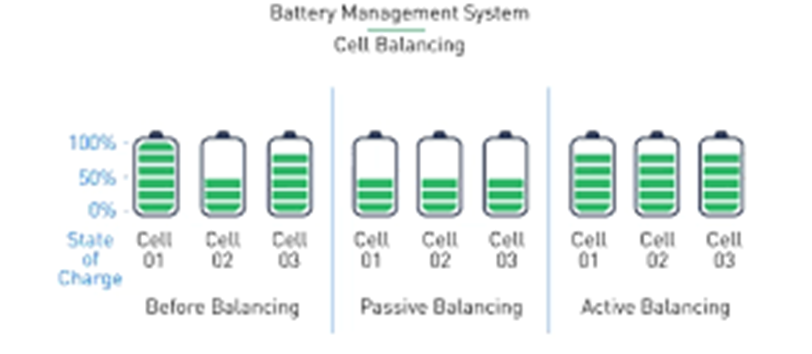
Active balancing employs switching circuits to redistribute energy among cells, minimizing waste and improving efficiency. This method, however, requires additional circuit components, increasing both costs and potential reliability issues. Active balancing strategies, known as topologies, range in complexity. The simplest topologies allow energy transfer only between adjacent cells, which can be insufficient for widely varying charge levels. More complex topologies allow for flexible, system-wide balancing but require numerous components, adding cost and reducing reliability.
Given the central role of charge balancing in battery health, significant research is underway to design topologies that optimize balancing with minimal components. Future advancements in passive and active balancing are expected to bring increased efficiency and reliability to BMS designs.
Summary
The Battery Management System (BMS) might not be as widely discussed as the battery itself, but its role in electric vehicles is absolutely essential. The BMS safeguards the battery against potential misuse and damage, extends its lifespan, and ensures it’s always ready for optimal performance.
Each BMS design is a balance of cost, efficiency, and durability, with safety as the non-negotiable priority. Adhering to ISO 26262 safety standards, the BMS must be fail-safe, featuring redundancy measures like independent processor units and dedicated memory devices.
For the safety and reliability of electric vehicles, the BMS is a vital component and deserves as much recognition as the battery itself, if not more.